
 Autor:
 El Cachivache’s tango music is written in a distinctly energetic style, filled with humour, references to punk, the raw immediacy of suburban milongas, and a sharp, lively spirit.
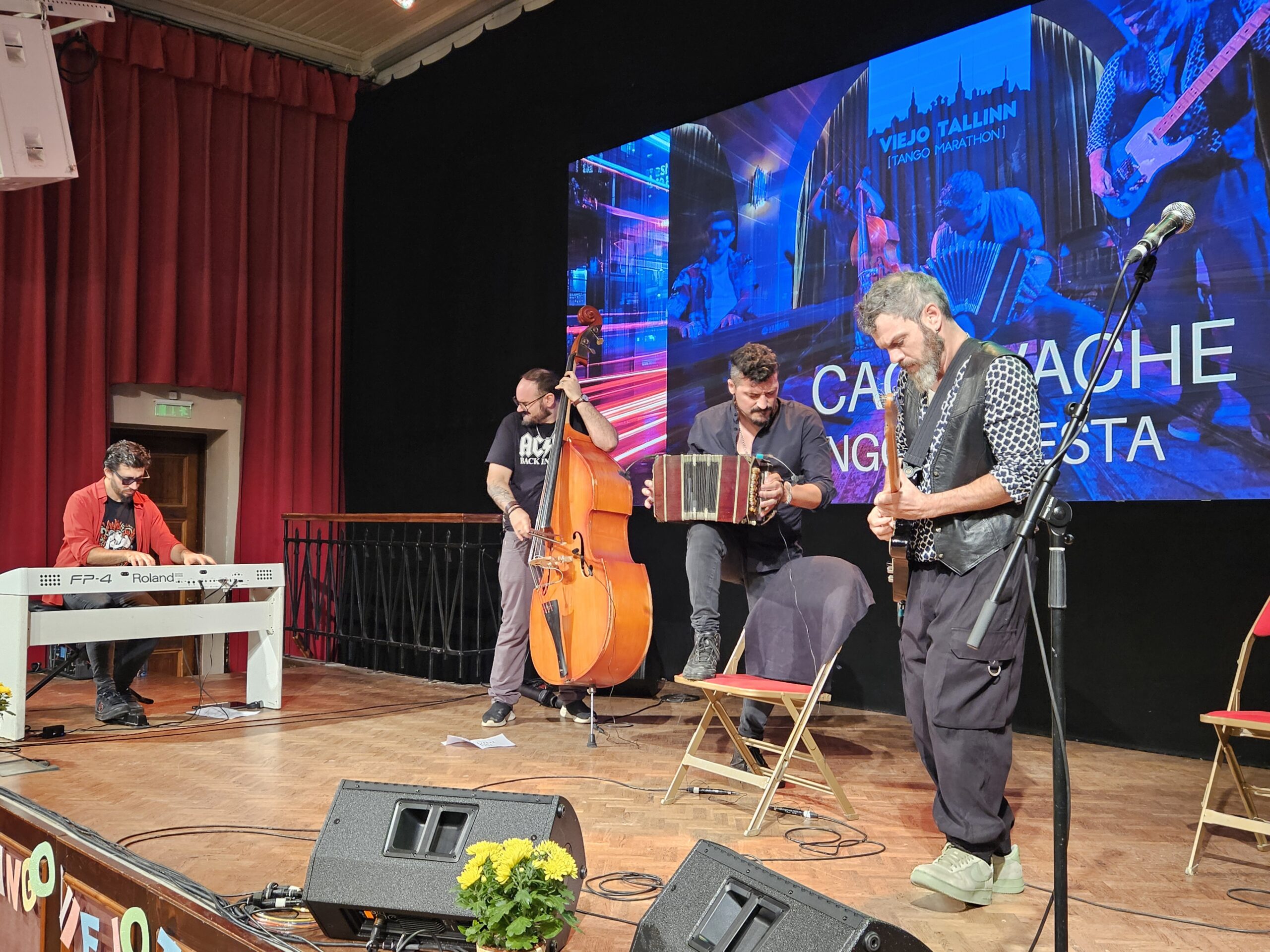
The day after El Cachivache’s concert-milonga in Tallinn in May 2025, Vito Venturino (guitar), Andy Ferrari (piano), Adriano De Vita (bandoneon), Pacha Mendes (double bass), and Gianina Druta (vocals) gather around a café table, while tango enthusiast Kai Randrüüt, Tango Viejo Tallinn Marathon organizer Olesya Nesteruk, and Aleksander Laane ask the questions. El Cachivache will be in Tallinn again on May 3, 2026.
How did you all end up in Cachivache?
Vito Venturino: I was a rock musician in the 90s and I got into tango later.
Pacha Mendes: I have been everywhere. For example, I played folk music, but also till 2012 I used to play thrash metal. But it was like a hobby, and later it became a job. And at some point, I got into tango and forgot about everything else.
Kai Randrüüt: Can you say also why?
Pacha: Because it got a hold of me. I was interested more in tango as a music genre more than anything else. And also because of my… it was my job. I needed to work more. So I just got to play tango music. So I switched instruments. I used to be an electric bass player. I switched to contrabass. And after six months, I met this guy (Vito) and this band. And I started playing with Cachivaches. And since then, it was… almost everything was Cachivache in my life. And then I started dancing tango, and it was all about that.
Kai: Do you feel like you are stuck in the tango culture?
Pacha: No, I can get out. I mean that we can spend some weeks without playing and a couple of months without dancing. Not for good, but just for a little bit. It’s more than an acquired taste. It’s a way of life, I think.
The first Piazzolla was so catchy
Kai: Adriano, are you from a folk music background?
Adriano De Vita: No, I don’t play folk music. I played a wind instrument like a trombone. I studied classical music. Then I started to listen Piazzolla. And because of that, I got into bandoneon, first of all. And then tango afterwards.
Vito: Piazzolla is also a world in itself, and it’s very difficult to get out of it once you enter it. And without dancing.
Andy Ferrari: Yes, I have done a bit of everything. I used to play the guitar first in my adolescence. I played thrash metal, too. I had the Flying V guitar. I played Megadeth and that stuff. But then I started to study music at the conservatory. I made a whole conservatory of classical music. But as a job, I started to play in a series of tango groups without tango experience. And I learned to play tango music by performing in various groups. For a lot of years.
And I think for me it was very attractive because it was the opportunity to play very often in Buenos Aires. At that moment, 2014 and 2013, there were a lot of milongas, and it was very well paid. I remember I bought my first shoes with the money from the milongas.
And, well, that’s it. Maybe, yes, as for Adriano, the first Piazzolla was so catchy.
But then, when you get into it, you can find a lot of poetry. Yes, the tango has a world in itself that has poetry, dancing, music. Very interesting music because it has arrangements, it has the bandoneon, it’s an orchestra. I think for me it was so near to classical music than, for example, jazz or that kind of music. So that’s my story with tango.
So now I play tango almost every time. Maybe we can work on other gigs, with other kinds of music, but the main thing is tango.
Gianina Druta: And you play which instrument?
Andy: Ah, I play the piano, yes, yes. I switched because I started with the guitar first. But when I chose to study, I found that the piano was more interesting for classical music than the guitar. And so I chose the piano, and then I started to study piano formally in the conservatory.
Kai: And the fifth member of the band, as you said yesterday – Gianina! Where are you from?
Gianina: I’m from Romania. But I live in Norway. Can I speak Norwegian?
Kai: No, you have to speak English.
Gianina: I started to dance tango approximately eight years ago when I moved to Norway. Then I just kept dancing. But the thing was, when I started to dance, I got really interested in the music as well.
I remember that I started to sing the songs, because Romanian is in the same language family as Spanish, so it was easy for me to understand Spanish. And then I liked the lyrics of the songs, so I started to sing them as well. I’ve never imagined that I would ever get to sing tango, but I started as a dancer.
But then in 2023, there was this one group, a tango group in Oslo, and they invited me to sing with them. So I started as a singer in late 2023. And then in 2023, I met also Cachivache in Oslo during their European tour, and Vito asked me to help them with the musicality class. And since then, we kept in touch, and here we are today. He asked me a couple of days before the performance (in Tallinn) to sing with them. The magic of tango. So, here we are together.
Vito: At first, one of the nice things here is to be together with people from different generations – with Andy, we have a 12-year age gap. And then they come from different backgrounds.
Gianina: For example, Andy has this classical music background, a bit of heavy metal too, but he is much more anchored in the classical music background.
Vito: For example, our meeting with Gianina. She comes from another country, from Romania, then she lives in Norway, but still we have this encounter within tango.
Tango Was Reborn Through Crisis
Vito: Yes, but apart from that, I was also thinking, you know that tango, until more or less the year 2000, was kind of dead in Argentina. There was not much tango, neither new productions, nor listeners, nor almost milongas.
Yes, tango was dead in Argentina from more or less from the 60s to the 2000s. But you know, in 2000 in Argentina, we had a big crisis. Yeah. Super, super big crisis, a crash of the country, you know.
And I think this event was really important, but 10 years before that, we had a great global crisis with the Soviet Union and the world. So I think these two events were super, super important for the revival of tango. Especially from 2000, there was a revival of tango that was very powerful. I think with the end of communism and the fall of the Berlin Wall, this led to globalization and to this trend in which people connect much more to their roots and to the specificities of each place. And because of this crisis in 2000, I moved to Spain.
And then in Spain I used to play other genres like jazz and bossanova, but with tango it was this matter of coming back, returning to one’s own roots.
Pacha: In those same years, in the beginning of the 2000s, for example, I got heartbroken with the big bands. In Argentina, most big bands like Guns N’ Roses, Metallica, they always play there, and they say, and they promise that we are the best crowd in the world, the most passionate, the biggest crowd, that we are crazy, that we are the best, and everybody loves to go to Argentina to play.
But after the crisis, as we had our currency was crazy, I had tickets to go and see Metallica in a big stadium, and they cancelled the event because they said that they were tired, but we all knew that it was because we didn’t have real money. So I got pissed off at them. Like, so these guys are all about. It’s a business, I understand.
Argentina’s own heavy metal
Pacha: So I got heartbroken. At the same time, I was studying music in a school that belongs to the musicians’ union, so sometimes we had a lot of masterclasses of old maestros, tango musicians, and I could see them play the way they play. And also, I remember that there was a municipal tango orchestra rehearsing at my school, and there were like six very old guys, and they played amazingly well and with a very high volume.
So when they rehearsed, we couldn’t study around the other classrooms, because they were so loud. They played very well. So I started joking about how I found the Argentinian heavy metal, because these guys were very old, but they played really fast and really loud.
And I started getting attracted to that, like the same things that I liked about heavy metal, like the volume, the precision, the virtuosism of the instruments. I found it in these very old guys, and that got my attention. The same year, the beginning of the 2000s.
Tango, in its nature, is Cachivache
Kai: What’s the story behind your name – Cachivache? Directly translates to junk – things which you don’t use, but don’t throw away.
Pacha: Tango, in its nature, is Cachivache, because it was out of fashion for 40 years, but nobody threw it away. I think it has a lot to do with that.
Vito: When we started playing tango, we were musicians who had nothing to do with tango. And we were living in Spain. So, we felt really alone and isolated. Because who is going to tell us how to play this music? Tango has a lot of specificities. So there we were – we couldn’t go to concerts to see other orchestras or choose.
Kai: Was there any influence from your grandparents regarding tango?
Adriano: My father was singing tango. He wasn’t a famous singer. So he was singing in smaller places.
Andy: No, my grandfather is Italian. That’s the most tango thing you will hear. My grandmother, my mom, they were all Italian. They hardly ever danced tango. But I’m the first musician in the family, so the connection with tango was so light. Maybe some Julio Sosa.
Vito: As I told you before, we had a generational break in Argentina. So we have lost the link. Maybe our grandfather was a tango dancer or a listener. My parents, for sure, no.
Pacha: My grandparents danced tango. I know because my parents told me that. I didn’t know my grandparents. My mother knows the lyrics of almost every tango that was recorded in the 60s. But when I was younger, and she sang tango, I didn’t like it, because I thought it belonged to another generation – old people’s music. And my music was another thing. So later, I started to treasure it.
How is tango doing in Argentina right now?
Aleksander: How are local tango communities doing right now in Argentina?
Pacha: The tango scene in Buenos Aires is very big. Tango in Argentina is not a massive thing. It’s not that everybody knows how to dance tango. If you ask any random person about tango, they will tell you about two songs they know or about Julio Sosa, the singer that Andy’s grandparents liked.
Vito: Well, it’s true what you said. Not everybody knows tango, of course. But I think we cannot say that there is one certain tango community. There are a lot of people dancing. And there are also a lot of tourists going to dance. And there are a lot of different kinds of milongas. For different audiences. You can find big milongas, small milongas, cultural milongas, social milongas, underground milongas. Milongas, which are just for old people. I have been dancing for 15 years already. And for sure, I will go to milongas in Buenos Aires. I don’t know everybody for sure.
Pacha: Different tribes. There are some milongas. We go to those milongas, and we know a lot of people. Perhaps four blocks away, there is another milonga. We go there, and we don’t know anybody.
Vito: And nobody knows us. You know, there are milongas in the neighborhoods … In one neighborhood, you have five or six milongas. And in the other, five or six milongas. And some people who are dancing in the south of the city are not going to the north.
Andy: And there isn’t a south tango society, north or by a neighbor. You can choose the milonga where you like and go. And maybe there are people who go often, and you can meet them.
Vito: And you know, we still have milongas where men are sitting on one side of the milonga and women on the other side. And you can replace people, and you can only invite men, etc.
Pacha: And the organizer walks around, and if you are not dancing for a couple of tandas, they tell you, if you don’t dance next tanda, you’re going to sit in the last row.
Andy: The most surprising thing is that they invite us to play there.
Pasha: Sometimes we play there. Many people like those things.
Vito: Now I remember, in this milonga, super classical traditional milonga, four in the afternoon. Just for retirees. But a big one, I don’t know, 100 or 200 people dancing there. At some point, the organizer took the microphone and said, please, come on, you cannot make a boleo.
Pacha: Ah, yes. Because of the amount of people there.
Vito: Yes, the rules of the dance floor, you cannot make boleos. Please don’t do boleos.
La Cachivacheria!
Kai: Can you describe your favorite milonga crowd?
Vito: We have our own milonga there. Yes, very secret, very cozy. But I love this place.
Kai: Is it a secret place?
Vito: No, it’s not a secret place.
Pacha: The place is called La Cachivacheria! It’s not secret, I mean, it’s public. Not everyone knows about it. And it’s also a very relaxed milonga. But you would think that the people who go to our milonga look like us. Our milonga doesn’t have the same type of people. Older people, younger people, good dancers, terrible dancers. There are all sorts.
Andy: Our marketing level is like smuggling.
Vito: Works like a speakeasy: “La Cachivacheria is open, we can go, they say that on Wednesdays!”
La Viruta – heaven and hell together
Vito: I love very different places in Buenos Aires. One of those is La Viruta. For me, it is like heaven and hell together. It’s a very big place. Even on Wednesdays, you can keep on dancing til morning. There can be 400 people. It’s so serious.
Pasha: Til one or two o’clock, it isn’t very good there. The best part is around three and five o’clock. And there are a lot of people on Wednesdays and Sundays.
Vito: Every tourist who arrives at La Viruta says that it’s very difficult to dance here. And I’m inviting a woman, and she says no. And women say: “Nobody invites me there”. It’s a very difficult place. But I love it. It’s like the best. And then we also have a favorite place that is Zonatango. Zonatango is the opposite. It’s a clandestine secret in a house. Super amoral. Super bohemian. And it’s super, super nice with concerts, acoustic concerts. Yes. A lot of bands start there. Yes.
Tango, but very punk way
Kai: So many famous pairs have danced at your place. And you have filmed those dance videos. Do they come to you themselves? Or do you invite them? The world is watching those videos over and over again.
Vito: Actually, we started with one particular video, which was the boom video with Noelia and Carlitos in 2014. And that was a good point to start. Because we had the idea to dress them in a very punk way. And they are super classical dancers. Super classical! And we appear super punky, and they’re dancing in sneakers on the street, you know. And it was nice. Because after that video, during the next tour here in Europe, people came to our events in punk dress, wearing sneakers – Noelia’s sneakers. So after that video, a lot of dancers started to ask us to participate in videos. Yes!
A particularly important question 🙂
Kai: Is our Estonian tango community, you saw yesterday for the first time, different from others?
Vito: For sure, each country is different. The approach to tango will be different, right? But from my short experience yesterday, I mean, it was nice. The people were so nice. I danced a couple of tandas, super nice tandas. Yes, it was okay.
Andy: Maybe the euphoria doesn’t appear instantly – the applause comes in a little delay. For example, usually, at the end of the song, one or two seconds … and applause.
Vito: Here, it seemed like 30 seconds before applause (laughs). But, you know, if you want to change that in your community, it’s super easy. You need one person to start with a scream, then everybody starts.
Andy: But to put a contrast in that, in the musicality workshop we gave yesterday, people were not shy at all to ask, to share their thoughts.
Where would you like to go?
Kai: Are there any places you haven’t been, but you want to visit? Or would you like to return?
Andy: For me, that I am the newest, just repeating all the places that I have been. For me, it’s more than I can expect in my life.
Pasha: I, with Cachivache, have never been to Portugal, for example. Yes. But I don’t care about Portugal. I want to go to Beirut, for example.
Vito: I would like to go to Southeast Asia.
Adriano: Antarctica, maybe.
Vito: We were in Thailand one time. You saw all those countries that were there. Vietnam, Suriname, all of that. Ethiopia, Indonesia.
Adriano: The Caribbean, we could go to the Caribbean.
Pasha: Africa, South Africa.
El Cachivache’s favorites
Gianina: Would you mind telling us your favorite tango or tango orchestra? If you have one, of course.
Pasha: My favorite tango is the very old cheesy tango, not classy at all, and I don’t know the orchestra. And I don’t know why, but when I hear the melody, I really love it. I like a song called Fumando Espero. Very classy! That’s what I like. Then I can tell you that I really like Di Sarli, but I like that song in particular. I don’t know why.
Vito: I have a favorite now, in the last year or two, which is Fruta Amarga. I had an incredibly deep experience while dancing to it.
I was on the dance floor at a milonga, listening to the lyrics, and suddenly I started crying like a baby. I had to leave the dance floor because I simply couldn’t continue dancing. And ever since then, every time I dance to that song, I feel a profound emotion.
Adriano: Yes, Fruta Amarga is… I listened to it yesterday, and I almost listened to it again. It’s creamy. I really like the song by Lidia Borde with the orchestra El Arranque.
Pasha: That’s how much time we spend together! We have the same favorite tango.
Gianina: And the funny thing is that I’ve also been studying Fruta Amarga a lot lately, so we’re like … very connected.
Pasha: I have a question. What is the next song you’re going to play? Fruta Amarga! Let’s see! Andy?
Andy: I was thinking because I thought it was going to be the name of an artist and not a particular tango. The artist is the one and only Horacio Salgán.